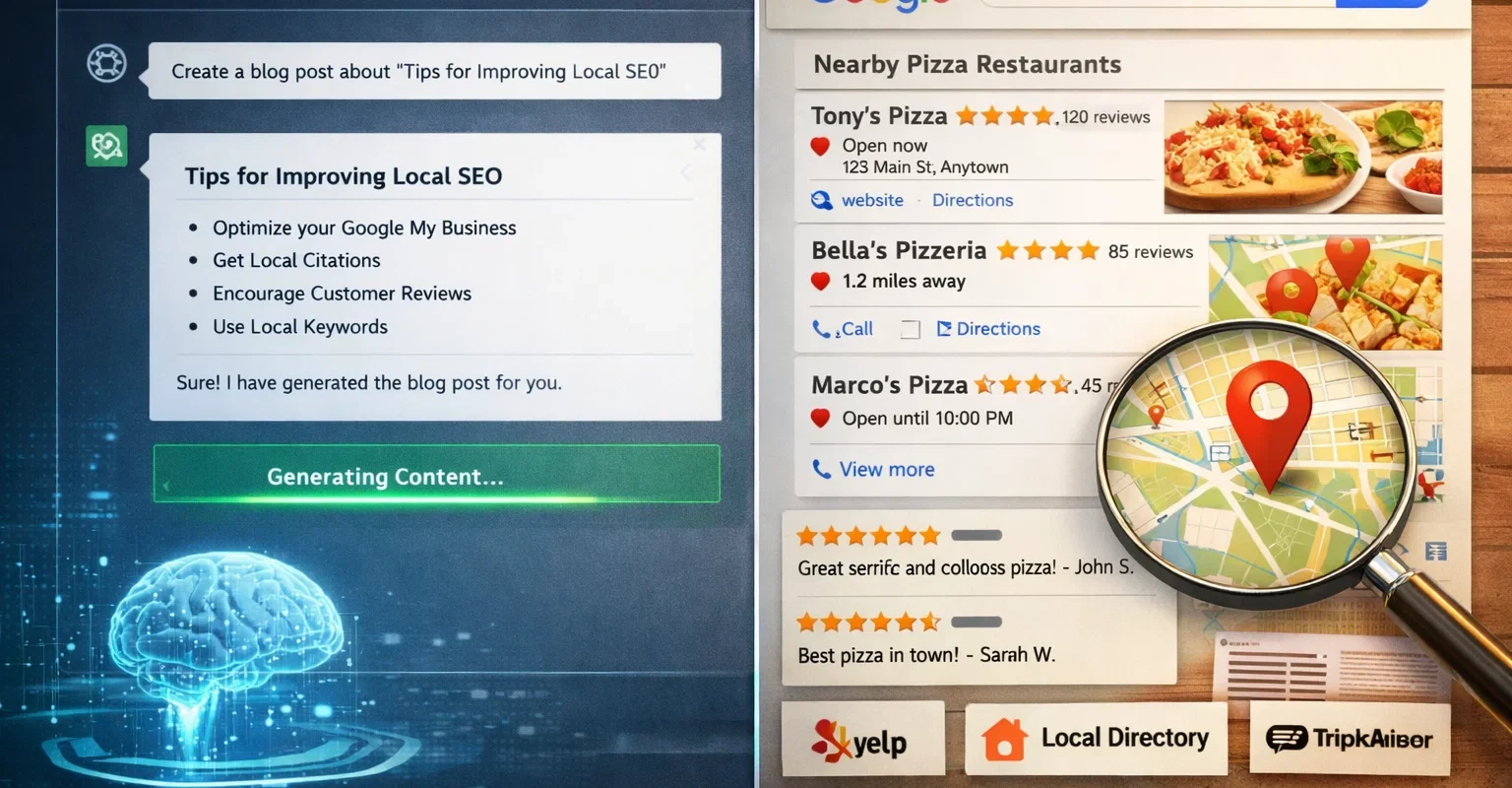
Yes, ChatGPT can be used in local SEO, but only for specific tasks. It is a capable tool for drafting content, generating keyword ideas, writing meta descriptions, and creating FAQ sections. However, it cannot access real-time search data, verify local rankings, audit your Google Business Profile, build citations, or replace the strategy and expertise required to actually rank in competitive Canadian local markets.
Key Takeaways
-
 ChatGPT is a writing and ideation tool, not a local SEO platform.
-
It has no access to real-time Google data, local rankings, or your business’s current search performance.
-
It can draft content, FAQs, and meta descriptions but cannot verify local keyword competitiveness or search volume.
-
AI-generated content used without human review often lacks the local specificity that actually ranks in city-level searches.
-
The tasks that move local rankings fastest like citation building, review acquisition, and Google Business Profile optimisation, cannot be done by ChatGPT.
-
Used correctly, ChatGPT saves time on content production but needs a trained local SEO strategy behind it to produce results.
Why So Many Business Owners Are Asking This Question
ChatGPT crossed 100 million users in just two months after launch, making it the fastest-growing consumer application in history. Naturally, business owners started asking whether they could use it to cut costs across every part of their operation, including SEO.
The short answer is that AI tools like ChatGPT have genuinely useful applications in an SEO workflow. But local SEO specifically involves a set of technical, real-world, and data-driven tasks that no AI language model can currently perform on its own. Understanding the line between what ChatGPT can help with and what it cannot do is the difference between using it as a useful tool and relying on it for things it is simply not built to handle.
This article walks through both sides clearly, so you know exactly how to think about AI in the context of your local SEO strategy in Canada.
What ChatGPT Can Actually Do for Local SEO
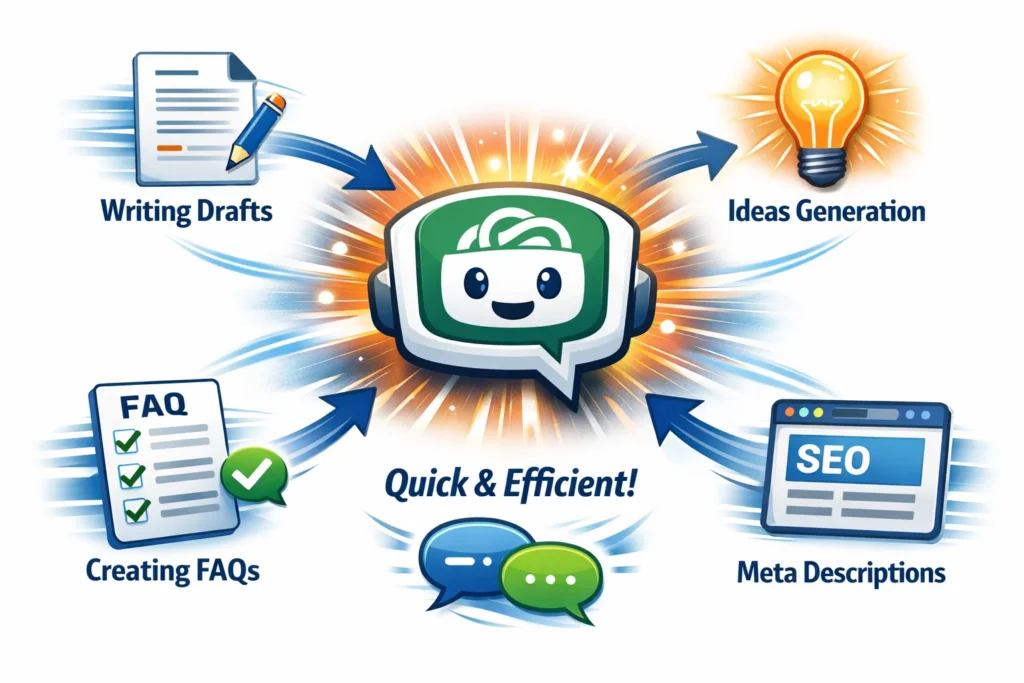
Let us be specific and honest here, because a lot of content on this topic swings to either extreme. ChatGPT is not useless for local SEO, but it is also not a local SEO tool. Here is where it genuinely adds value:
1. Drafting Location Page Content
If you need to build location pages for multiple Canadian cities, ChatGPT can produce a first draft quickly. Given a clear prompt that specifies the city, the service, the target audience, and the tone, it can produce a serviceable starting point that a human editor then shapes into content that is genuinely local and specific.
The key word there is starting point. Raw ChatGPT output for location pages tends to be generic. It doesn’t know that your roofing company in Kelowna serves the North Glenmore area, or that your dental clinic in Etobicoke is close to Sherway Gardens. That local specificity is what makes location pages rank. It has to be added by a human who knows the market.
2. Writing and Optimising Meta Titles and Descriptions
Meta descriptions are short, formulaic, and benefit from keyword inclusion and a clear call to action. ChatGPT is genuinely good at producing multiple variations quickly. You give it the page topic, the target keyword, and the character limit, and it produces several options to choose from.
This is a legitimate time-saver. A local SEO agency like SEO Service Canada uses AI assistance in this way, treating it as a drafting tool that a trained SEO professional reviews and refines, not as a final output generator.
3. Generating FAQ Content for Schema Markup
FAQ sections on local pages are valuable for two reasons: they help you rank for conversational and long-tail local queries, and they are eligible for FAQ schema markup that can display directly in Google search results.
ChatGPT can generate a solid bank of FAQ questions and answers for a specific service and location. For example, give it a prompt like: generate 10 FAQ questions a homeowner in Mississauga would ask before hiring a plumber, and it produces usable output that you then refine for accuracy and local specificity.
4. Building a Local Content Calendar
Ask ChatGPT to generate 20 blog post ideas for a family dental clinic in Halifax targeting local search traffic, and it will give you a reasonable starting list. Many of those ideas will be too generic, but some will point toward genuinely useful local topics that a good SEO strategy can develop.
It can also suggest content clusters, topic groupings, and supporting article ideas that help you structure a content strategy. Again, this is ideation assistance, not strategy. The decisions about which topics to prioritise, which have real search volume in your Canadian city, and which fit your competitive landscape require actual data and expertise.
5. Drafting Google Business Profile Descriptions
Your Google Business Profile description has a 750-character limit and needs to naturally include your primary service keyword and location while reading like something a real business wrote, not a keyword list.
ChatGPT handles this well when given specific inputs. Tell it your business name, what you do, your city and province, your primary keyword, and your tone of voice. It produces a clean draft in seconds. A human then reviews it for accuracy, local relevance, and anything the AI missed about the actual business.
Want to know how SEO Service Canada uses AI tools alongside real local SEO strategy?
We combine the efficiency of AI-assisted content production with expert local SEO strategy built specifically for the Canadian market. Get a free audit and see what a proper local SEO plan looks like for your business.
Book your free audit: https://seoservicecanada.com/contact/
WhatsApp us directly: https://wa.me/16469165108
What ChatGPT Can’t Do for Local SEO
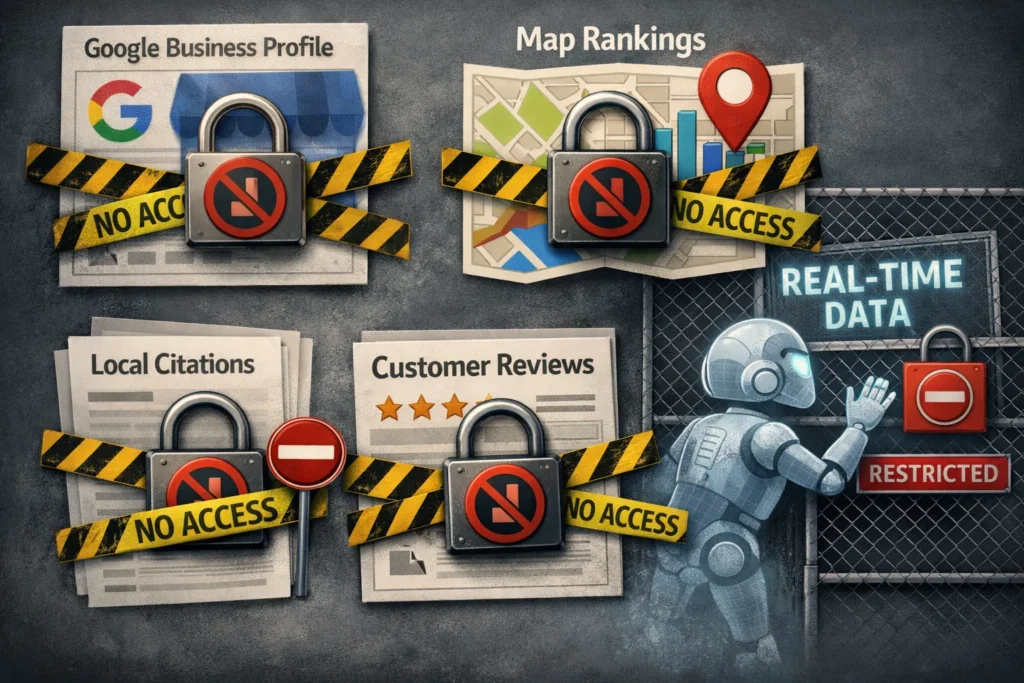
This is the part that matters most, because this is where the misconception causes real damage. Business owners who rely on ChatGPT for the following tasks end up with a local SEO strategy that looks active but produces no ranking movement.
1. It Can’t Tell You What Is Actually Ranking in Your City Right Now
ChatGPT has a training data cutoff. It does not have access to live Google search results. It cannot tell you who is currently ranking in the map pack for your target keywords in your specific Canadian city. It cannot tell you what your competitors are doing, what content they have, or how strong their local authority is.
This is fundamental. Local SEO strategy is built on real competitive data. Which businesses rank in the map pack for your primary keywords? How many reviews do they have? How complete is their Google Business Profile? What local citations do they have that you do not? None of this can come from ChatGPT. It requires actual tools and a trained analyst reviewing real data.
2. It Can’t Audit or Optimise Your Google Business Profile
Your Google Business Profile is the most important local ranking asset you have. Optimizing it properly requires accessing the profile directly, reviewing which categories are selected, assessing photo quality and quantity, checking for suppressed reviews, identifying missing service listings, and comparing your profile completeness against the top-ranking competitors in your area.
ChatGPT cannot log into Google. It cannot see your profile. It cannot tell you that your primary category is set incorrectly, that you are missing 14 service listings, or that your photos are five years old. These are things a local SEO specialist identifies in an audit. They cannot be replaced by AI content generation.
3. It Can’t Build or Fix Your Local Citations
Citation building means manually claiming and verifying your business listing across dozens of Canadian directories, ensuring your name, address, and phone number match exactly on every one. This is painstaking, manual work.
Citation auditing means identifying every directory where your information appears incorrectly and correcting it. ChatGPT cannot search the web for your business listings, identify inconsistencies, or submit corrections to directory platforms. It has no ability to interact with external systems. This work requires real tools and real human effort.
4. It Can’t Get You Google Reviews
Reviews are one of the top three local ranking factors according to multiple industry studies. Building a review acquisition process, following up with customers, responding to every review, and managing your online reputation is a relationship-driven activity. ChatGPT can help you draft a review request message template. But it cannot send those messages, follow up with customers, or respond to reviews on your behalf in a way that is genuinely personalised.
5. It Can’t Do Local Link Building
Getting a link from your local chamber of commerce, a regional news site, or a neighbourhood blog requires real outreach. It means finding the right contact, writing a pitch that is relevant to that specific publication, and building a relationship. ChatGPT can help you draft an outreach email, but the research, targeting, and follow-through are entirely human tasks.
6. It Makes Up Facts and Local Details
This is a serious risk that business owners need to understand. ChatGPT is a language model. It is designed to produce fluent, coherent text. When it does not know something, it often generates plausible-sounding information that is simply incorrect.
Ask it to write about the local business environment in Regina and it may produce content that reads convincingly but contains inaccurate local details. Use that content on your website and you end up with local pages that mislead readers and, when Google identifies the inaccuracies, undermine your credibility.
Any content produced by ChatGPT for local SEO needs to be fact-checked and enriched with real, locally accurate information before publication. This is not optional. It is the difference between content that ranks and content that harms your site.
Tried using AI for your local SEO and not seeing results?
You are not alone. SEO Service Canada works with Canadian businesses that have tried DIY and AI-assisted approaches and still are not ranking. A free audit shows you exactly what the gap is and what real local SEO strategy can do to close it.
Book your free audit: https://seoservicecanada.com/contact/
WhatsApp us directly: https://wa.me/16469165108
The Right Way to Use ChatGPT in a Local SEO Workflow
AI tools are most valuable when they handle the repetitive, time-consuming parts of content production while a trained SEO professional handles strategy, data analysis, and execution. Here is a practical workflow that reflects how good local SEO agencies, including SEO Service Canada, approach this:
- Keyword and competitor research first. Use real SEO tools to identify which local keywords have search volume in your Canadian city and who is currently ranking for them. ChatGPT plays no role in this step.
- Use ChatGPT to draft content outlines and first drafts. With the keyword data and competitive insights in hand, use AI to produce a fast first draft of location pages, blog posts, or FAQ sections.
- Human review and localisation. A trained editor reviews every piece of AI output, adds real local specifics, removes generic filler, fact-checks every claim, and ensures the content actually serves the reader’s intent.
- Technical implementation. Schema markup, internal linking, page structure, and site speed are all handled by a technical SEO specialist. ChatGPT cannot touch any of this.
- Off-page execution. Citation building, review acquisition, and local link building are executed manually. AI assists with drafting outreach messages but cannot replace the process.
- Ongoing performance monitoring. Actual ranking data, Google Search Console analysis, and monthly reporting require real tools and a trained eye. AI generates no data.
ChatGPT and AI Answers: What This Means for Your Local SEO Visibility
Here is a layer that most businesses are not thinking about yet. AI-powered search features, including Google’s AI Overviews and conversational search results, are becoming a bigger part of how people find local businesses.
When someone asks an AI search tool a question like “who is the best plumber in Scarborough,” the AI pulls its answer from structured, well-optimised online sources. Businesses that have strong local SEO fundamentals, clear Google Business Profiles, consistent citations, and well-structured location pages with schema markup are the ones that get cited in AI-generated answers.
This means that the traditional local SEO fundamentals are not becoming less important in an AI-driven search world. They are becoming more important. AI answer engines need clean, structured, accurate, locally specific information to cite. Businesses that provide that through proper local SEO work are the ones that appear in AI answers. Businesses relying on generic AI-generated content that lacks local depth and accuracy are not.
At SEO Service Canada, we build local SEO strategies that are optimised not just for traditional Google rankings but for the AI-driven answer formats that are increasingly shaping how Canadian consumers find local businesses.
A Honest Summary: ChatGPT as a Tool, Not a Strategy
Here is the straight answer that this whole article has been building toward.
ChatGPT is useful. It saves time on drafting. It helps generate content ideas. It writes decent first drafts when given clear instructions. For a small business producing local content on a limited budget, it reduces the time cost of content creation.
But it is a tool, not a strategy. It does not know your market. It cannot see your rankings. It cannot fix your citations, earn you reviews, or build the local authority signals that Google actually uses to decide who ranks in the map pack in your Canadian city.
The businesses that rank in local search in competitive Canadian markets are the ones with properly executed local SEO strategies behind them. Some of them use AI tools to speed up parts of that process. None of them rely on AI tools as a substitute for the actual work.
Frequently Asked Questions
The Bottom Line for Canadian Business Owners
ChatGPT is a capable assistant for parts of the content side of local SEO. It is not a local SEO strategy. It cannot rank your business. It cannot fix what is broken. And it cannot replace the expertise, tools, and consistent execution that local search rankings actually require.
If you are a Canadian small business trying to figure out whether AI tools can replace a proper local SEO investment, the honest answer is no. But used correctly within a real strategy, they can help you produce content faster and more efficiently.
SEO Service Canada builds local SEO strategies for Canadian businesses that combine smart use of available tools with the real expertise that moves rankings. If you want to know where your local SEO stands and what it would take to start ranking in your city, start with a free audit.
Get your FREE local SEO audit from SEO Service Canada: https://seoservicecanada.com/contact/
Or message us on WhatsApp: https://wa.me/16469165108