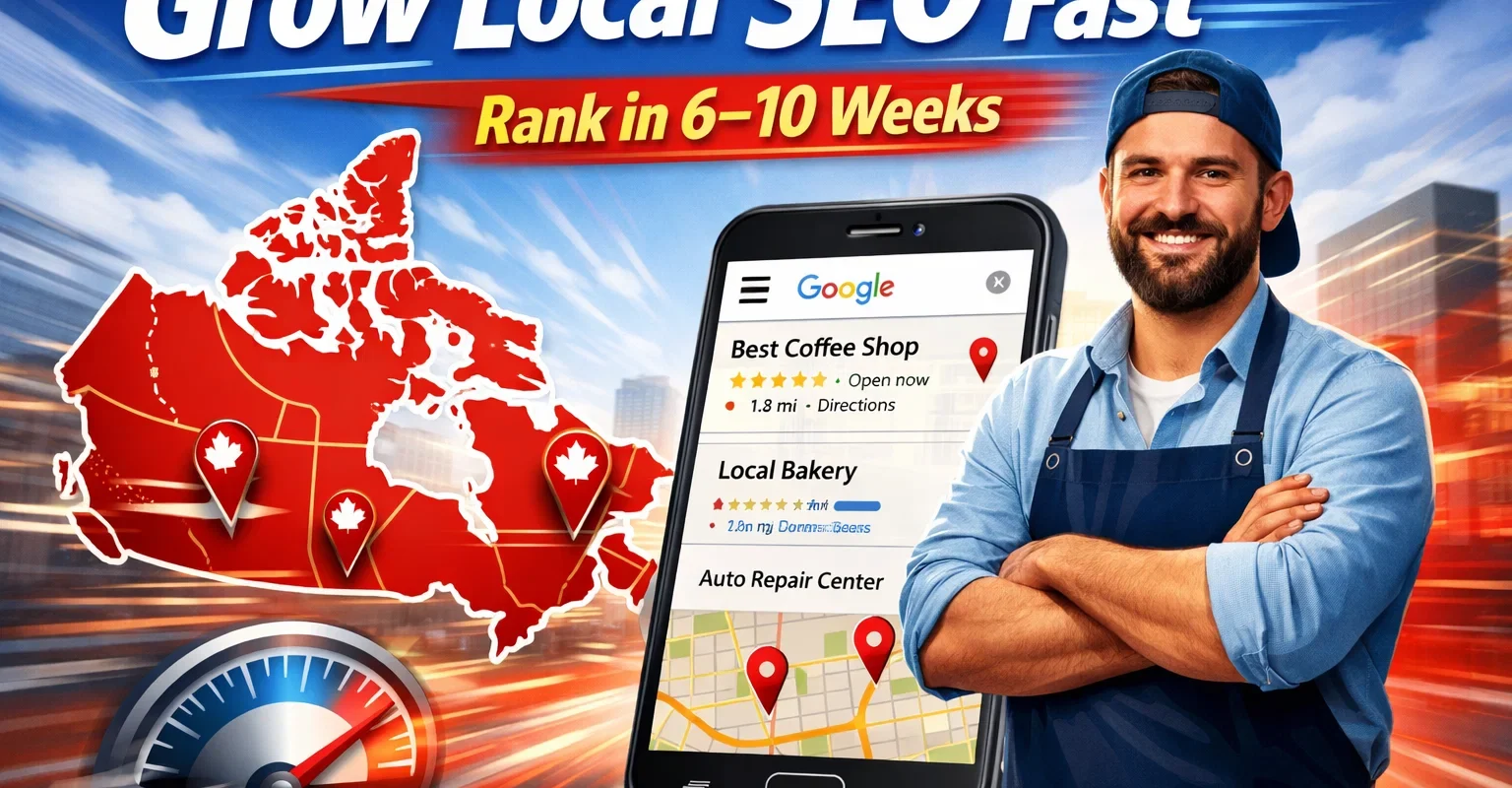
The fastest way to grow local SEO is to fully optimize your Google Business Profile, fix NAP inconsistencies across all directories, and actively collect Google reviews. These three actions alone can move a business into the local map pack within 6 to 10 weeks. Everything else builds on this foundation.
Key Takeaways Before We Get Into It
- Google Business Profile is the single highest-impact action you can take right now.
- NAP consistency across all online directories is a foundational ranking signal Google relies on.
- Review velocity (getting reviews regularly, not all at once) ranks higher than a one-time burst.
- Local citations on Canadian-specific directories accelerate trust faster than general ones.
- Location pages on your website with real, unique content give you a ranking advantage most competitors skip.
- Local link building from Canadian sources is a long-term accelerator that compounds over time.
Why Most Businesses Grow Local SEO Slowly (And How to Avoid It)
The number one reason Canadian small businesses do not grow their local SEO fast is that they treat it like a one-time task instead of an ongoing process. They claim their Google Business Profile, fill in some basic information, and then forget about it.
Google’s local search algorithm is live. It is constantly re-evaluating which businesses deserve to appear in the local map pack. Businesses that are actively updating their profiles, collecting reviews, building citations, and publishing local content consistently signal to Google that they are engaged and trustworthy.
The businesses that grow fastest are not doing anything exotic. They are doing the basics exceptionally well, consistently. That is the actual fast track.
Step 1: Treat Your Google Business Profile Like a Second Website
If you only do one thing after reading this, make it this. Your Google Business Profile is the most direct lever you have for local map pack rankings. According to a BrightLocal study, Google Business Profile signals account for approximately 36% of local pack ranking factors.
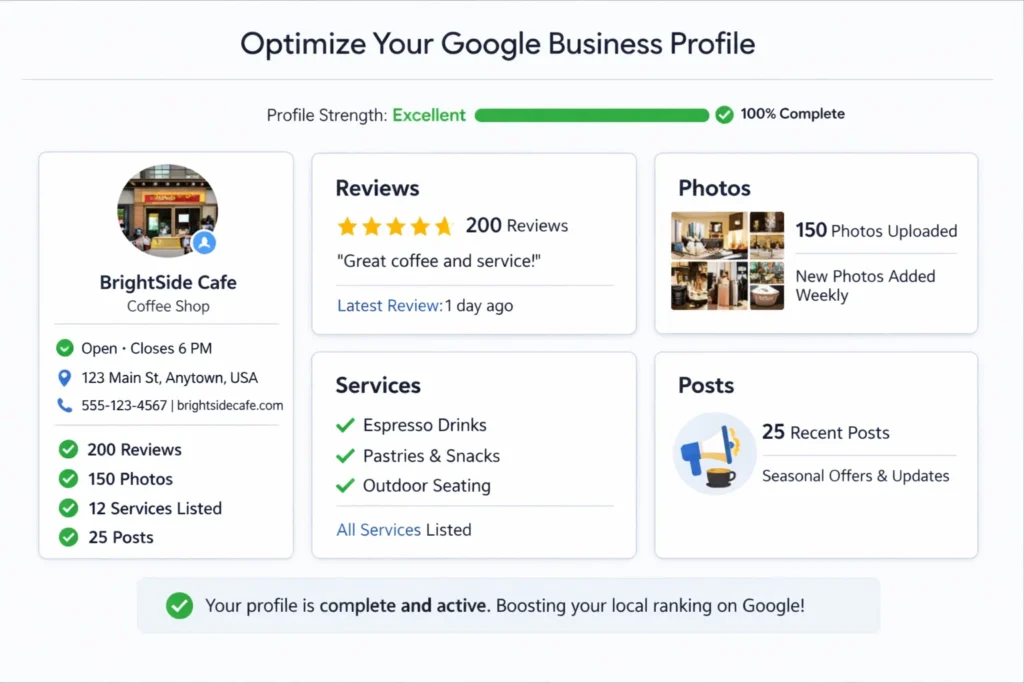
Most Canadian businesses have a profile that is 50 to 60 percent complete. That isn’t enough.
Here is what full optimisation looks like:
- Primary and secondary categories: Choose the most specific category for your business, then add all relevant secondary categories. Wrong categories kill visibility.
- Business description: Write a natural 750-character description that includes your primary service keyword and your city. Do not stuff it. Write it like a human.
- Services section: List every service you offer individually. Each service listing is an opportunity to match a search query.
- Photos: Businesses with more than 100 photos get 520% more calls than those with fewer than 10, according to Google’s own data. Start uploading consistently.
- Google Posts: Post weekly updates, offers, or tips through the Posts feature. It signals to Google that your business is active.
- Q&A section: Seed this yourself with common questions and detailed answers. These appear on your profile and Google indexes them.
- Attributes: Fill in every applicable attribute. Women-led, wheelchair accessible, serves dine-in, accepts credit cards. Every attribute adds local relevance signals.
Step 2: Fix Your NAP Consistency Across Every Directory
NAP stands for Name, Address, and Phone number. Google cross-references your business information across dozens of online directories to verify that you are who you say you are and that you are where you say you are.
If your business is listed as “Smith HVAC” on Google, “Smith HVAC Services” on Yelp, and “Smith Heating and Cooling” on Yellow Pages Canada, Google sees three different entities. That inconsistency dilutes your local authority instead of building it.
For Canadian businesses, the key directories to audit and correct immediately are:
- Google Business Profile
- Yelp Canada
- Yellow Pages Canada (YP.ca)
- Canada411
- Better Business Bureau Canada
- Apple Maps
- Bing Places
- Facebook Business
- Industry-specific directories relevant to your niche (Houzz for contractors, RateMDs for clinics, etc.)
Run a citation audit before building new citations. Fixing bad data is more important than adding new listings.
Not sure if your business information is consistent across the web?
SEO Service Canada runs a full local citation audit as part of every free SEO audit we provide. We find the inconsistencies and fix them. Canadian businesses, every province.
Book your free audit: https://seoservicecanada.com/contact/
WhatsApp us directly: https://wa.me/16469165108
Step 3: Build Review Velocity, Not Just Review Volume
This is a distinction most business owners don’t understand. Getting 30 reviews in one week and then nothing for six months looks suspicious to Google. It can actually trigger a review filter that suppresses some of those reviews from showing publicly.
What Google rewards is review velocity: a steady, consistent stream of new reviews over time. Even two or three new reviews per month, maintained consistently, outperforms a one-time surge.
The data backs this up: According to BrightLocal’s Local Consumer Review Survey, 98% of people read online reviews for local businesses. And 57% of consumers will only use a business if it has four or more stars. Reviews aren’t optional. They are part of the purchase decision.
Here is a simple review process that works for Canadian businesses:
- Ask immediately after a positive experience, not days later when the customer has moved on.
- Send a direct link to your Google review page so there is zero friction. The easier you make it, the more reviews you get.
- Follow up once for customers who said they would leave a review but did not.
- Respond to every review, positive and negative. Businesses that respond to reviews rank higher and convert more searchers into customers.
- Never incentivise reviews with discounts or gifts. It violates Google’s policies and can get your profile penalised.
Step 4: Build Local Citations on Canadian Directories First
A citation is any online mention of your business name, address, and phone number. It does not need to be a link. Even unlinked mentions on trusted directories send local trust signals to Google.
Most generic SEO guides recommend citation building on US-centric directories. That is not the best strategy for Canadian businesses. Google gives higher weight to geographically relevant citation sources.
Beyond the core directories listed above, look for province-specific and industry-specific directories in Canada. A contractor in Ontario should be listed on sites like HomeStars. A healthcare clinic should be on Medimap or similar Canadian health directories. A restaurant should be on Zomato Canada and OpenTable.
Stat worth knowing: According to Whitespark’s Local Search Ranking Factors report, citation signals account for roughly 7 to 10% of local pack rankings. In a competitive market, those points matter.
Step 5: Add Location-Specific Pages to Your Website
Your website needs to tell Google exactly where you operate and what you do in each location. A single homepage with your city mentioned once is not enough for competitive local markets.
If you serve multiple neighbourhoods or cities, each one deserves its own page. These are not thin pages with the city name swapped in. Each location page needs:
- A unique H1 that includes your service and the specific city or neighbourhood.
- Genuinely local content that describes how your service works in that area, local context, nearby landmarks or references.
- An embedded Google Map showing your location or service area.
- LocalBusiness schema markup so Google can read your address, phone, hours, and service area directly from the page code.
- A clear call to action specific to that location.
According to Moz, on-page local signals including city and region-specific content account for roughly 13 to 14% of local organic ranking factors. That is a significant share you leave on the table if your website has no location pages.
Step 6: Get Local Backlinks from Canadian Sources
Backlinks from locally relevant Canadian websites carry outsized weight in local search rankings compared to generic links. Google uses these links to confirm that your business is genuinely part of a local community.
The best local backlink sources for Canadian businesses:
- Local newspapers and regional news sites (a mention or feature article is valuable)
- Your local chamber of commerce directory
- Business improvement areas (BIAs) in your city
- Local event sponsorships that include a website listing
- Province-specific business associations
- Local bloggers or community websites that cover your industry or neighbourhood
You do not need hundreds of these. Five to ten high-quality local Canadian backlinks will move your local rankings faster than fifty generic directory links.
Want a faster path to local search rankings in your Canadian city?
SEO Service Canada builds local SEO strategies specifically for Canadian markets. We handle citation building, Google Business Profile optimisation, local content, and link building. Start with a free audit and see exactly where you stand.
Book your free audit: https://seoservicecanada.com/contact/
WhatsApp us directly: https://wa.me/16469165108
Step 7: Publish Local Content Consistently
Content is where local SEO compounds fastest over time. Every piece of locally relevant content you publish gives Google another reason to show your business for a wider range of local queries.
This does not mean publishing generic blog posts about your industry. It means writing content that is genuinely useful to people in your specific city or province. Examples:
- A roofing company in Calgary writing about how Alberta hail damage affects roof warranties.
- A dental clinic in Halifax writing about what to look for in a family dentist in Nova Scotia.
- A real estate agent in Mississauga writing about the difference between buying in Mississauga versus downtown Toronto.
- A gym in Kelowna writing about the best outdoor workout spots in the Okanagan for when the gym gets crowded.
This kind of content is genuinely useful. It ranks because people in those cities are actually searching for it. And it positions your business as the knowledgeable local authority in your field.
What Fast Local SEO Growth Actually Looks Like: A Realistic Timeline
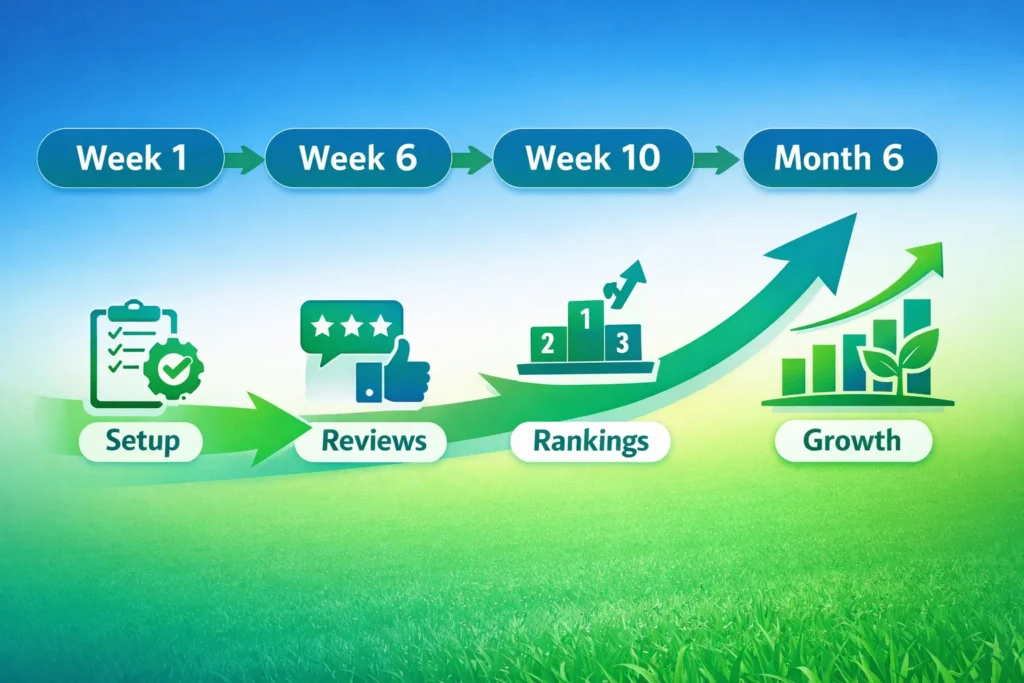
- Weeks 1 to 2: Google Business Profile fully optimised. Citation audit complete. NAP inconsistencies fixed. Local keyword mapping done.
- Weeks 3 to 6: Review acquisition process in place and running. New citations built on priority Canadian directories. First location page published.
- Weeks 6 to 10: First map pack appearances for lower-competition queries. Search Console impressions are growing. Early review impact visible.
- Months 3 to 4: Consistent map pack visibility. Local keyword rankings climbing. Content strategy producing early traffic.
- Months 4 to 6: Compounding results. Multiple keywords ranking. Reviews are strong. Local link building adding authority.
- Months 6 to 12: Stable top-of-page presence for core local keywords. Traffic and leads growing month over month without proportional increase in effort.
6 Common Mistakes That Slow Down Local SEO Growth
Avoiding these errors will save you months of lost time:
- Using a different business name in different places. Inconsistency confuses Google. Standardise your name everywhere.
- Targeting keywords that are too broad. “SEO services” is a national term. “SEO services in Burnaby” is a local term. Know the difference.
- Ignoring negative reviews. Not responding to negative reviews signals to potential customers and Google that you are disengaged.
- Choosing the wrong Google Business Profile category. This is one of the most common and most damaging mistakes. The wrong category means you are optimised for the wrong searches.
- Publishing thin location pages. A location page with 150 words and a city name is not a location page. It is a placeholder that Google will not rank.
- Building citations on irrelevant directories. A Canadian restaurant does not need to be listed on a US-based contractor directory. Relevance matters.
Frequently Asked Questions
Start Growing Your Local SEO Faster with SEO Service Canada
Every week your business doesn’t appear in local search results is a week your competitors are getting the calls, the bookings, and the customers that should be coming to you. The gap widens the longer you wait.
SEO Service Canada works with Canadian small and medium-sized businesses across every province to build local search visibility that is fast, sustainable, and built on the strategies outlined in this guide. No long-term contracts. Transparent monthly reporting. A team that understands the Canadian local search landscape.
Get your FREE local SEO audit from SEO Service Canada: https://seoservicecanada.com/contact/
Or message us directly on WhatsApp: https://wa.me/16469165108